Why CRUDAuth?
CRUDAuth handles authentication for FastAPI: sessions, JWT, OAuth, and email flows, over your own SQLAlchemy user model. This page covers what it does, what it doesn't, and when to use something else.
Auth is small to write and easy to get wrong
A login endpoint is a dozen lines. The security-relevant part is what those lines leave out:
@app.post("/login")
async def login(form: OAuth2PasswordRequestForm = Depends(), db=Depends(get_session)):
    user = await get_user_by_username(db, form.username)
    if not user:
        raise HTTPException(401, "Bad credentials")     # returns faster than the real
                                                        # path, so it leaks which
                                                        # usernames exist

    if not bcrypt.checkpw(form.password.encode(), user.hashed_password.encode()):
        raise HTTPException(401, "Bad credentials")     # no lockout, and bcrypt cuts
                                                        # the password off at 72 bytes

    return {"token": jwt.encode({"sub": str(user.id)}, SECRET)}   # can't be revoked
This works; it's also a user-enumeration timing oracle, has no brute-force lockout, truncates long passwords, and issues tokens you can't revoke. None of that shows up in a demo; it shows up in a pentest.
CRUDAuth turns the hardened behavior on by default; mounting the router gives you login,
logout, register, and /me with escalating lockout, timing-equalized verification, a
SHA-256 pre-hash so bcrypt never truncates, synchronizer-token CSRF, trusted-proxy IP
handling, and token revocation:
auth = CRUDAuth(
    session=get_session,
    user_model=User,
    SECRET_KEY="change-me"
)
app.include_router(auth.router)
You CAN write the hardened version yourself; the point is not having to rebuild and re-audit it in every project.
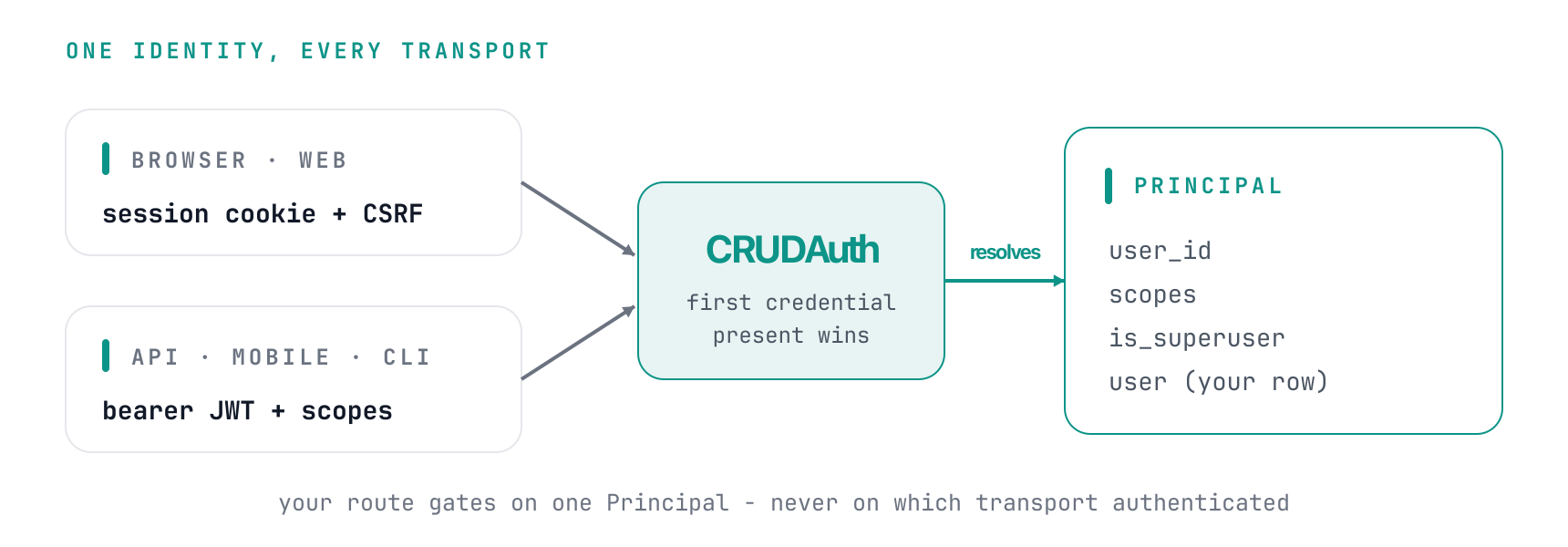
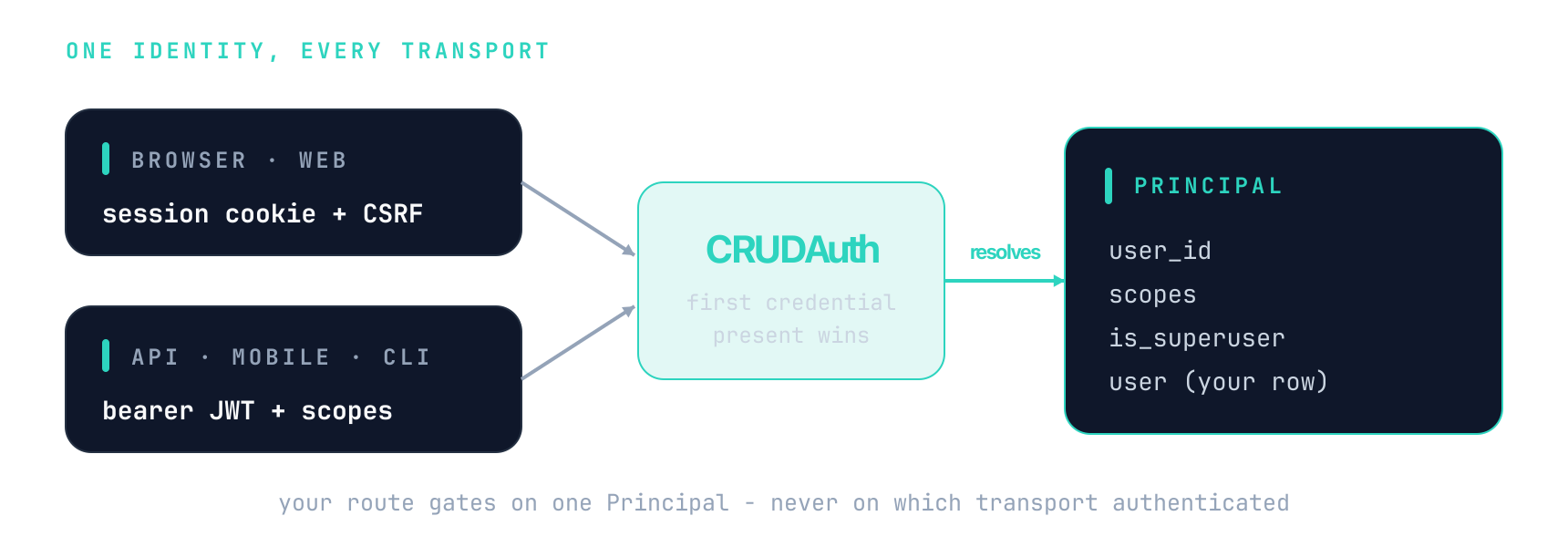
One identity, regardless of transport
A browser app wants a cookie session with CSRF. An API, mobile app, or CLI wants a stateless bearer token. Many libraries tie one of those to the dependency your routes call, so supporting both means a second identity path through every endpoint.
CRUDAuth resolves any transport to the same Principal. Your route asks for the principal;
it never depends on how the request authenticated.
Adding bearer tokens to a session app is a change to your CRUDAuth(...) config, not to
your authorization code:
@app.get("/me")
async def me(user: Principal = Depends(auth.current_user())):
    return {"id": user.user_id}      # same whether a cookie or a token authenticated
When more than one credential is present, the first transport you list wins. Gates like
superuser, scopes, and verified are expressed once, against the principal.
Your user model stays yours
CRUDAuth adapts to your SQLAlchemy model instead of owning it. Inherit a mixin, or map the logical fields onto a table you already have:
# greenfield: inherit the columns crudauth needs, add your own freely
class User(Base, AuthUserMixin):
    full_name: Mapped[str | None] = mapped_column(default=None)

# existing table: map the contract instead of renaming your schema
auth = CRUDAuth(
    session=get_session, user_model=LegacyAccount, SECRET_KEY=...,
    column_map={
        "id": "account_id",
        "email": "email_address",
        "hashed_password": "pw_hash"
    },
)
Side effects (welcome email, trial grant, audit log) go in hooks, not a fork of the library. A hook fires on every path that creates or authenticates a user, so password signup and OAuth signup run the same code:
async def welcome(user, *, db, context):
    await send_welcome_email(user["email"])

auth = CRUDAuth(..., hooks=AuthHooks(on_after_register=welcome))
What CRUDAuth doesn't do
CRUDAuth is a focused library, not an identity platform.
Reach for something else when
You want a ready-made user-management UI. CRUDAuth gives you the auth surface, not the screens. Pair it with CRUDAdmin.
You'd rather not run auth at all. A hosted provider (Auth0, Clerk, WorkOS) owns more of the problem, at a price and a vendor dependency.
You need enterprise SSO. CRUDAuth does OAuth 2.0 social login, not SAML or SCIM provisioning.
You only need one "Sign in with Google". A single OAuth flow with no sessions or
registration is lighter with Authlib directly.
You're not on FastAPI and SQLAlchemy. CRUDAuth is built on both.
Adopt it incrementally
Each step is additive, and none of them change how your routes authorize:
- Start with sessions. The default gives cookie auth, CSRF, lockout, and the auth routes.
- Add an API. Put
BearerTransport()intransports=. - Add social login. Pass
oauth={...}with your provider credentials. - Add email flows. Implement the
EmailSenderport; CRUDAuth signs and verifies the tokens. - Harden for production. Move backends to Redis, set
trusted_proxy_hops, gate sensitive actions behindsudo. - Add policy. Register
AuthHooksfor welcome emails, trials, and audit logging.