Onboard an existing users table
You're adding auth to an app that already has a users table, with your own column names:
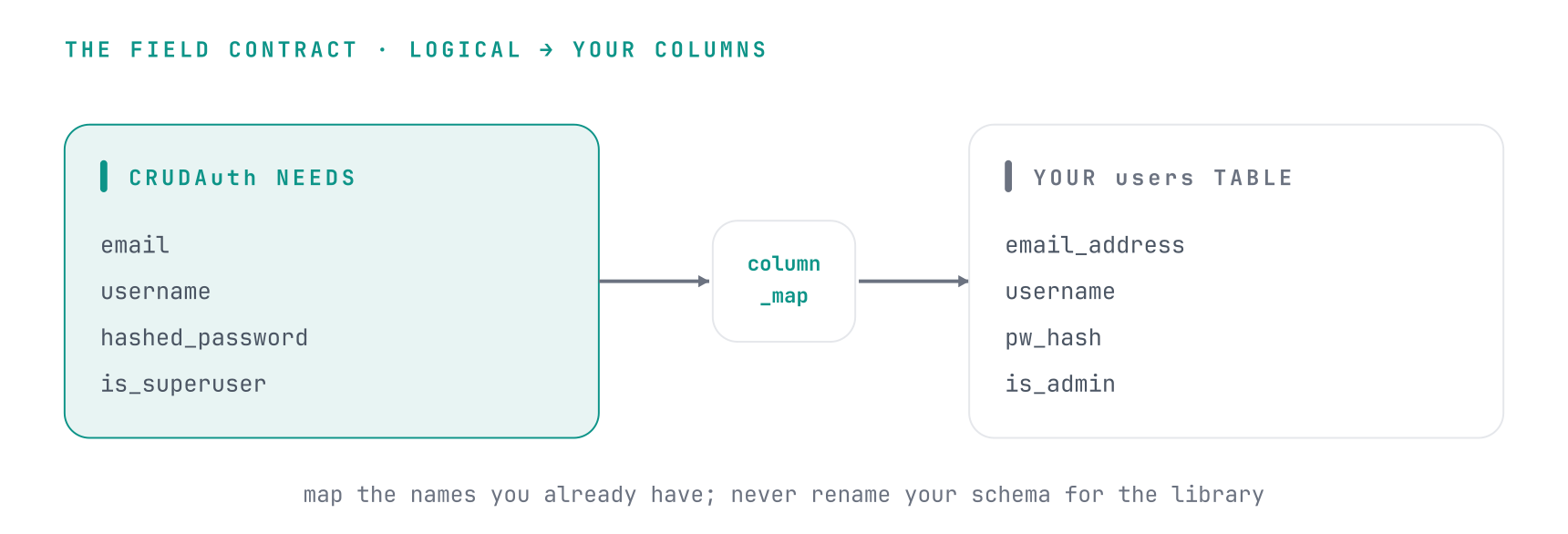
email_address, pw_hash, is_admin, maybe an integer account_id primary key. CRUDAuth speaks
in logical field names (email, hashed_password, is_superuser, and so on), and column_map
bridges the two, so you adopt the library without renaming a single column.
1. Map the names you already have
Say this is the table you already run:
from sqlalchemy.orm import Mapped, mapped_column
from myapp.db import Base

class User(Base):
    __tablename__ = "users"
    account_id: Mapped[int] = mapped_column(primary_key=True)
    email_address: Mapped[str] = mapped_column(unique=True)
    username: Mapped[str] = mapped_column(unique=True)
    pw_hash: Mapped[str] = mapped_column()
    is_admin: Mapped[bool] = mapped_column(default=False)
    # ... your own columns, untouched
Pass column_map as logical-name to your-column-name, and list only the ones that differ:
auth = CRUDAuth(
    session=get_session, user_model=User, SECRET_KEY="change-me",
    column_map={
        "id": "account_id",
        "email": "email_address",
        "hashed_password": "pw_hash",
        "is_superuser": "is_admin",
    },
)
Now CRUDAuth reads account_id where it means the user id, writes pw_hash for the password hash,
and checks is_admin for the superuser gate, while your schema stays exactly as it is. A column
whose name already matches (username here) needs no entry.
2. Add the bookkeeping columns you don't have
Your model needs a column for every logical field CRUDAuth actually uses. The identity ones you already have (mapped above); the bookkeeping ones may be new to your table:
token_version(int, default0) — the revocation epoch. Without it, bearer tokens aren't epoch-revocable and a password reset can't evict the user's other sessions. Add it if you use bearer tokens or want reset-as-eviction.email_verified(bool, defaultfalse) — required for the verification flow and thecurrent_user(verified=True)gate.is_active(bool, defaulttrue) — lets you deactivate an account; absent, everyone is treated as active.
These degrade gracefully when missing (CRUDAuth assumes active, unverified, epoch 0), so add only the ones whose feature you actually want. A migration that adds them with the defaults above is the whole job.
3. Registration still writes only what you allow
Mapping names loosens nothing. The registration allowlist is enforced on the logical fields and
their mapped columns, so is_admin is exactly as ungated as is_superuser would be: a request
can't set it through the renamed column either. Your own columns ride alongside, untouched.
What this buys you
The point of the field contract is that CRUDAuth never imposes a schema on you. It depends on a small
set of logical fields and reads them through column_map, so an existing table keeps its names, its
primary-key type, and its conventions, and auth fits around it. You add the few bookkeeping columns
whose features you want, map the rest, and nothing about your current model has to move.
Where to go next
- Set server-owned columns on new accounts: Server-set fields at signup.
- The contract in depth: UserRepository and Modeling your user.