Bearer tokens
Bearer tokens are the transport for non-browser clients: APIs, mobile apps, and CLIs. A
client logs in once, gets a short-lived access token, and sends it in the Authorization
header. CRUDAuth issues stateless JWTs and pairs them with a long-lived refresh token.
from crudauth import CRUDAuth, SessionTransport, BearerTransport

auth = CRUDAuth(
    session=get_session, user_model=User, SECRET_KEY="change-me",
    transports=[SessionTransport(), BearerTransport(access_ttl=900, refresh="cookie")],
)
Adding BearerTransport contributes two routes: POST /token to log in and POST /refresh
to mint a new access token.
Access and refresh tokens
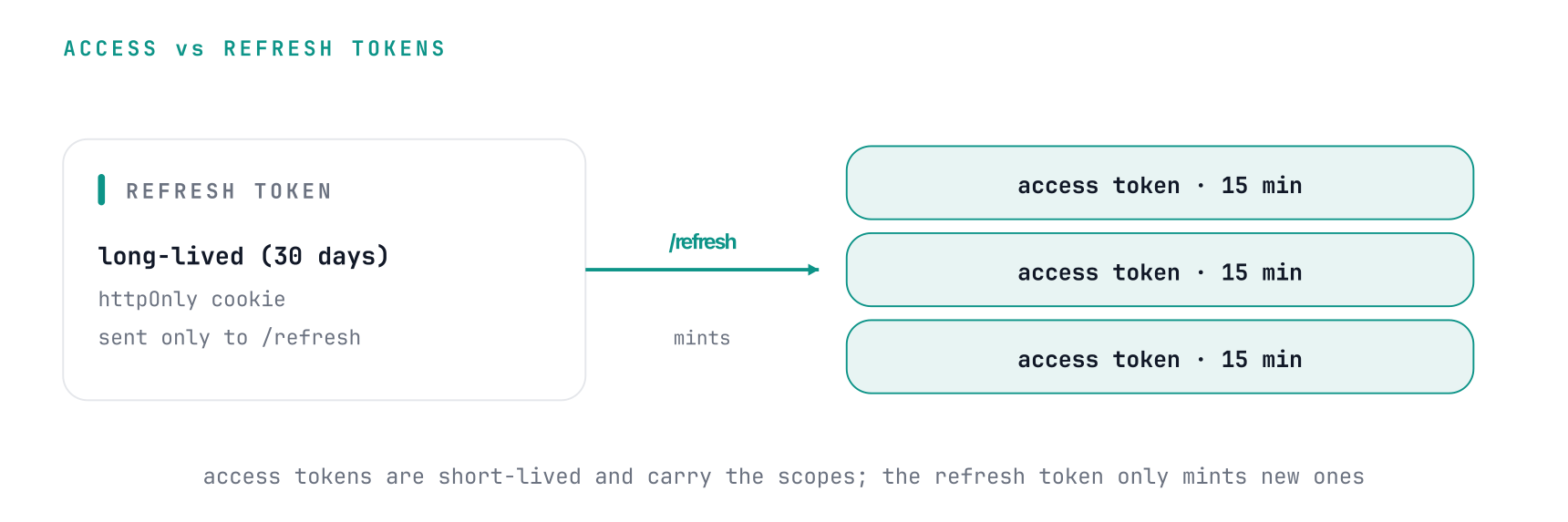
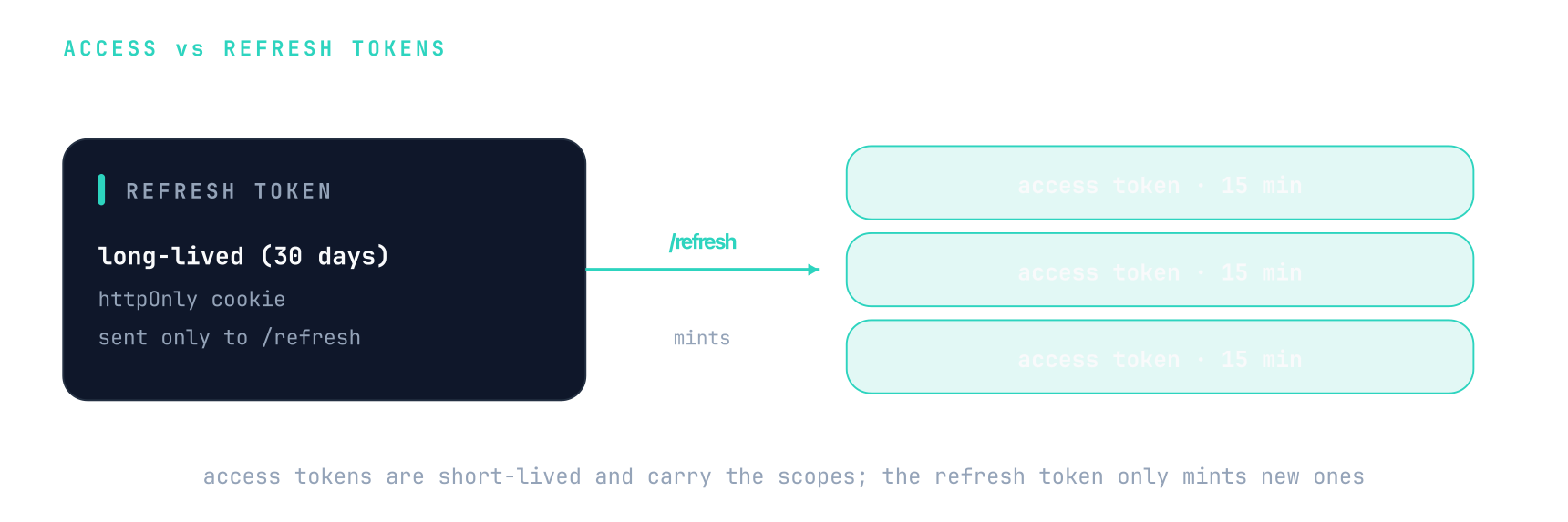
The access token is short-lived (15 minutes by default) and carries the scopes. The refresh token is long-lived and only used to mint new access tokens. Keeping access tokens short limits the damage if one leaks, since it expires quickly and can be revoked.
Getting a token
POST /token takes form-encoded credentials and returns the access token:
curl -X POST https://api.example.com/token \
  -d "username=alice&password=hunter2"
# {"access_token": "eyJ...", "token_type": "bearer"}
By default the refresh token is set as an httpOnly cookie (refresh="cookie"). Set
refresh="body" to return it in the JSON response instead, which suits CLIs and mobile
clients that store it themselves.
Using a token
Send the access token in the Authorization header. Your route gates the same way as any
other transport:
@app.get("/me")
async def me(user: Principal = Depends(auth.current_user())):
    return {"id": user.user_id}
Refreshing
When the access token expires, call POST /refresh to get a new one. With the cookie
strategy the refresh token rides automatically; with the body strategy, send it yourself.
curl -X POST https://api.example.com/refresh   # refresh cookie sent automatically
# {"access_token": "eyJ...", "token_type": "bearer"}
Scopes
Bearer credentials carry scopes, and routes can require a subset:
auth = CRUDAuth(
    ..., transports=[BearerTransport(
        default_scopes=["me:read"],
        grantable_scopes=["me:read", "reports:read", "reports:write"],
    )],
)

@app.get("/reports")
async def reports(user: Principal = Depends(auth.current_user(scopes=["reports:read"]))):
    ...
grantable_scopes is the ceiling: a token can never request or refresh into scopes beyond
it, so a credential can't widen its own authority.
Minting a token in your own code
/token is the usual entry, but you can mint a token pair anywhere (a webhook, an exchange
endpoint, a script) with auth.issue_tokens:
It's the same issuance /token uses: scopes are clamped to grantable_scopes and both tokens
carry the token_version epoch. Reach for it instead of the raw token functions, which skip the
clamp and the epoch. See Use the building blocks.
Revoking tokens
JWTs are stateless, so they can't be deleted one by one. CRUDAuth embeds a token_version
epoch in every token and stores it on the user. A password reset bumps the user's
token_version, which invalidates every token issued before the reset in one step.
Configuration
| Parameter | Default | What it does |
|---|---|---|
access_ttl |
900 |
Access token lifetime, in seconds. |
refresh_ttl_days |
30 |
Refresh token lifetime, in days. |
refresh |
"cookie" |
Where the refresh token lives: "cookie" (httpOnly) or "body". |
default_scopes |
None |
Scopes granted when none are requested. |
grantable_scopes |
None |
The ceiling of scopes a token may hold. |
refresh_cookie_path |
None |
Restrict the refresh cookie to a path (e.g. /refresh). |
See the bearer transport reference for the full surface.