Sessions
Sessions are CRUDAuth's default transport. With no transports= argument you get cookie
auth backed by a server-side session store, CSRF protection, and the /login, /logout,
/register, and /me routes:
from crudauth import CRUDAuth

auth = CRUDAuth(session=get_session, user_model=User, SECRET_KEY="change-me")
app.include_router(auth.router)
To configure it, pass a SessionTransport explicitly:
from crudauth import CRUDAuth, SessionTransport, CookieConfig

auth = CRUDAuth(
    session=get_session, user_model=User, SECRET_KEY="change-me",
    redis_url="redis://localhost:6379/0",
    transports=[
        SessionTransport(
            session_timeout_minutes=30,
            max_sessions_per_user=5,
            cookies=CookieConfig(secure=True, samesite="lax"),
        ),
    ],
)
The routes you get
| Method & path | What it does |
|---|---|
POST /register |
Create an account (email, username, password). |
POST /login |
Log in with a configured login field (username or email by default) + password; sets the cookies. |
POST /logout |
Terminate the current session and clear the cookies. |
GET /me |
Return the authenticated user's identity. |
POST /login is a form post and accepts a remember_me flag (see below). To gate your own
routes, see Protecting routes.
A login of your own
Need a custom login (a different form, an extra step)? Call auth.authenticate_password for the
hardened credential check (the shared lockout, timing-equalized verification, and the
disabled-account check) and establish the session yourself, instead of reassembling those by hand:
@app.post("/my-login")
async def my_login(body: LoginIn, request: Request, response: Response, db: DbDep):
    user = await auth.authenticate_password(db, body.username, body.password, request=request)
    sid, csrf = await auth.sessions.create_session(request, user_id=auth.repo.user_id(user))
    auth.sessions.set_session_cookies(response, sid, csrf)
    return {"csrf_token": csrf}
A wrong password raises UnauthorizedException, a tripped lockout RateLimitException - the same
responses /login gives. See Use the building blocks.
A logout of your own
A logout route of your own (an HTML form that redirects, say) calls the transport's
complete_logout, which does what POST /logout does: it ends the session the request's cookie
names, clears every transport's cookies and runs on_after_logout. A live session still needs the
X-CSRF-Token header; one that already expired is just cleared.
transport = SessionTransport()
auth = CRUDAuth(..., transports=[transport])

@app.post("/admin/logout")
async def admin_logout(request: Request, db: DbDep):
    response = RedirectResponse("/admin/login", status_code=303)
    await transport.complete_logout(request, response, db)
    return response
It returns True if a session was ended and False if there was none.
How a session works
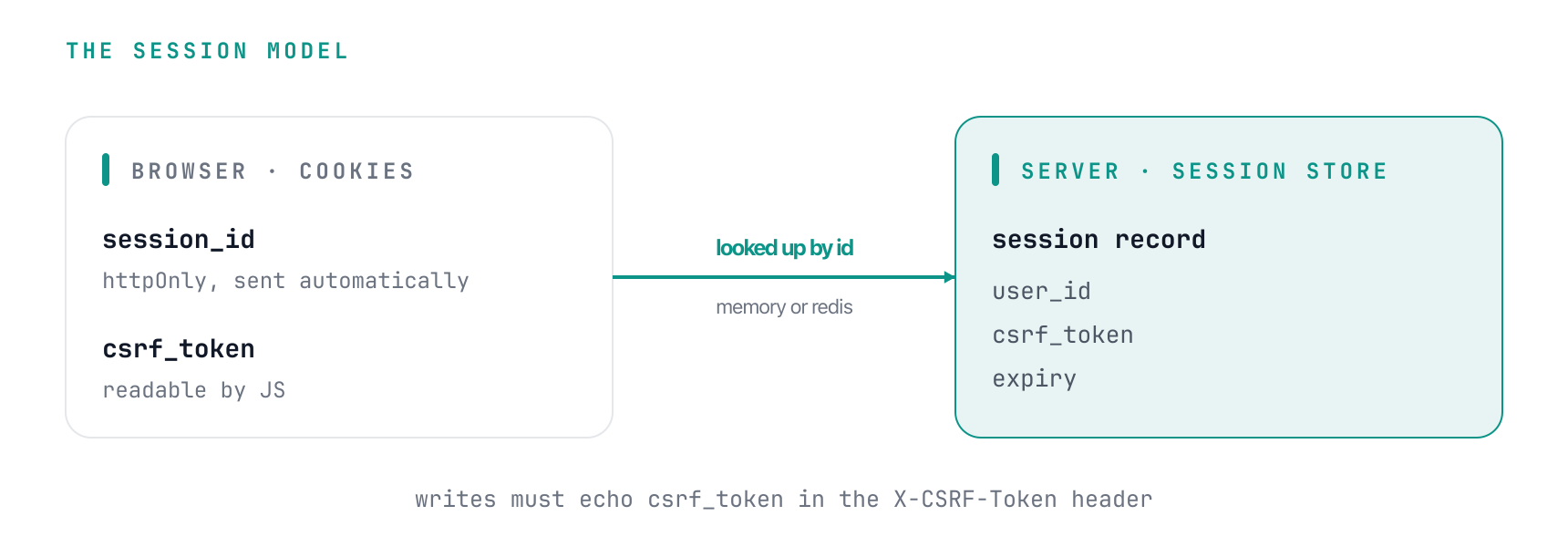
On a successful POST /login, CRUDAuth:
- Verifies the credentials (with lockout and timing equalization).
- Creates a session record in the backend (in-memory or Redis).
- Generates a CSRF token bound to the session.
- Sets an
httponlysession_idcookie and a readablecsrf_tokencookie.
On later requests the session transport reads session_id, validates it against the backend,
slides its idle timeout forward, and (on unsafe methods) checks CSRF before returning the
Principal.
The store never holds the session id or the CSRF token themselves: each is kept under an HMAC of
its value keyed with your SECRET_KEY. Whoever can read Redis can't sign in with what they read,
and changing SECRET_KEY signs everyone out.
Signing in again from a browser that still presents a session ends that session first. The browser drops the old cookie anyway, so it stays usable only to whoever copied it. Other browsers' sessions are untouched.
CSRF
CSRF is on by default and uses the synchronizer-token pattern. The csrf_token cookie is
not httponly so your frontend can read it and echo it back in the X-CSRF-Token header
on mutating requests (POST, PUT, PATCH, DELETE):
function csrfToken() {
  return document.cookie.split("; ").find(c => c.startsWith("csrf_token="))?.split("=")[1];
}

await fetch("/account", {
  method: "POST",
  headers: { "X-CSRF-Token": csrfToken(), "Content-Type": "application/json" },
  body: JSON.stringify({ ... }),
});
A mutating request with a missing or wrong header is rejected with 403. Safe methods
(GET, HEAD, OPTIONS) are exempt. You can disable CSRF with SessionTransport(csrf=False),
but don't unless something else terminates CSRF in front of crudauth.
Remember me
POST /login accepts a remember_me form field. When set, the session and its cookie get
the longer remember_me_days lifetime instead of the default idle window:
Cookie policy
CookieConfig controls the cookie attributes:
secure=True (the default) means the cookies are only sent over HTTPS. For local development
over plain HTTP, set secure=False so the browser will store them. SessionTransport rejects
samesite="none": session cookies stay lax or strict, so the frontend and the API must be on
the same site (for example app.example.com and api.example.com). For a frontend on another
site, use a bearer token.
POST /login refuses a request the browser marks Sec-Fetch-Site: cross-site with 403, so
another site can't sign a visitor into an account it controls. POST /logout clears the session
cookies, and the bearer refresh cookie when a BearerTransport with refresh="cookie" is
configured. It also works after the session expired: there is nothing left to protect, so it
just clears the cookies.
A session remembers the user's token_version from login. A password reset or change bumps it,
which ends every other session, including one whose login checked the old password just before
the reset and was stored just after.
Multi-device sessions
Each login is a separate server-side session, so you can build "manage devices" and "sign
out everywhere" on top of auth.sessions:
@app.get("/account/sessions")
async def list_sessions(user: Principal = Depends(auth.current_user())):
    return await auth.sessions.list_for_user(user.user_id)

@app.post("/account/sessions/{session}/revoke")
async def revoke_session(session: str, user: Principal = Depends(auth.current_user())):
    await auth.sessions.revoke_by_handle(session, owner_id=user.user_id)

@app.post("/account/sign-out-everywhere")
async def sign_out_all(user: Principal = Depends(auth.current_user())):
    await auth.sessions.revoke_all(user.user_id)
max_sessions_per_user caps how many concurrent sessions a user can have; the oldest is
evicted past the cap.
Session lifetime
session_timeout_minutes (default 30) is an idle timeout: every authenticated request slides it
forward, so a session in use never ends on its own. absolute_timeout_hours caps a session from
sign-in, however active it stays, for an app that wants a periodic re-login:
It's unset by default.
Two apps side by side
Two apps that both run CRUDAuth, an admin panel mounted beside the main app for instance, must not share a session namespace. On one Redis, the same storage prefix lets a session id from one app resolve in the other; in one browser, the same cookie name lets the second login overwrite the first. Give the embedded app its own names:
SessionTransport(
    cookie_name="admin_session",
    csrf_cookie_name="admin_csrf",
    storage_prefix="admin:session:",
    csrf_storage_prefix="admin:csrf:",
)
Their lockout counters need the same care. On a shared Redis or counter table, failures in one app
would lock the same username or IP out of the other. Give the embedded app's rate limiter its own
prefix with CRUDAuth(..., rate_limit_prefix="admin:rl:"), or, when you pass rate_limiter=
yourself, redis_rate_limiter(..., prefix="admin:rl:") or store.rate_limiter(prefix="admin:rl:").
Your own session store
To keep sessions somewhere other than memory or Redis (a database table, Memcached), implement
AbstractSessionStorage and pass a store of sessions and one of CSRF
tokens:
SessionTransport(storage=DatabaseSessions(prefix="session:"), csrf_storage=DatabaseCSRF(prefix="csrf:"))
The stores carry their own prefix and expiration, so they can't be combined with backend,
redis_url, redis_client or storage_prefix, and csrf_storage is required while CSRF is on.
auth.initialize() and auth.shutdown() open and close them like the built-in ones.
Backends and lifespan
The in-memory backend is per-process, which is fine for development but breaks under multiple
workers. Use Redis in production, or your own database through CRUDAuth(database_store=...) when
you run several workers without Redis (Storage): it carries the
lockout counters across workers too. Open and close the connections in your app's lifespan:
from contextlib import asynccontextmanager

@asynccontextmanager
async def lifespan(app):
    await auth.initialize()
    yield
    await auth.shutdown()

app = FastAPI(lifespan=lifespan)
The full set of knobs is on the
SessionManager reference.