Protecting routes
auth.current_user() builds a FastAPI dependency that authenticates the request and returns
a Principal. Every authorization rule is a keyword on that one
factory, so you compose access control instead of writing it.
from fastapi import Depends
from crudauth import Principal

@app.get("/dashboard")
async def dashboard(user: Principal = Depends(auth.current_user())):
    return {"id": user.user_id}
With no keywords it just requires a valid credential: an authenticated request gets the
Principal, an anonymous one gets 401 Unauthorized.
The Principal
Whatever transport authenticated the request, the dependency yields the same object:
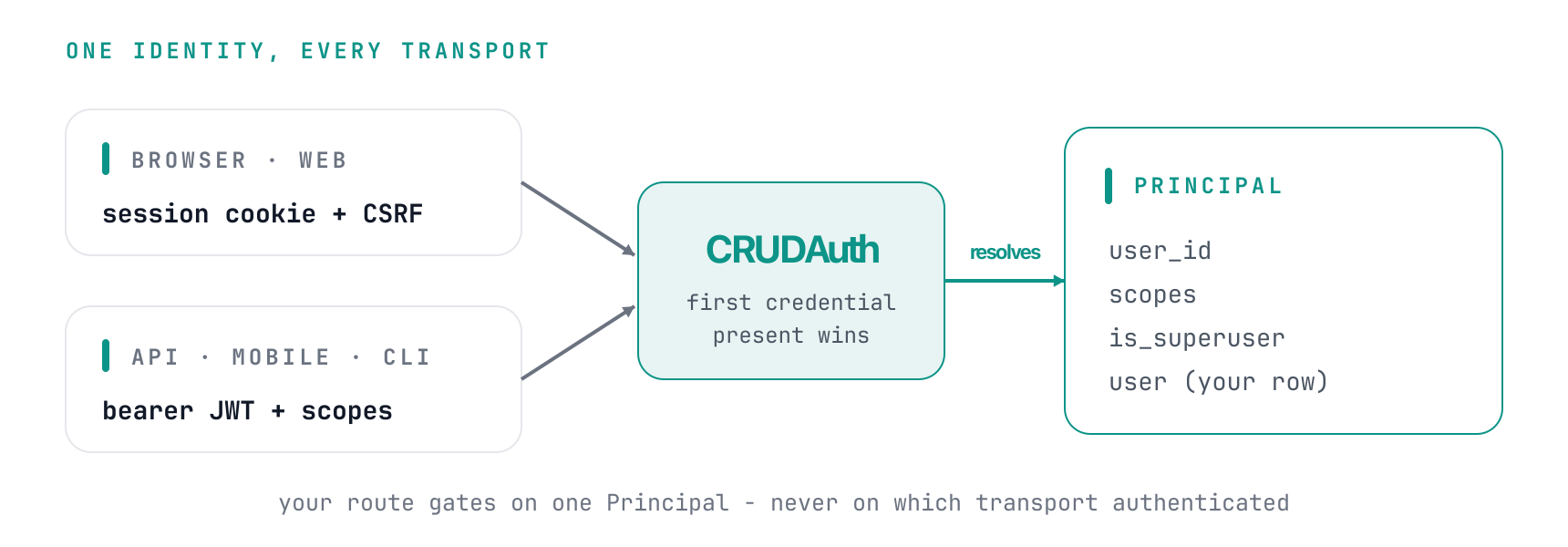
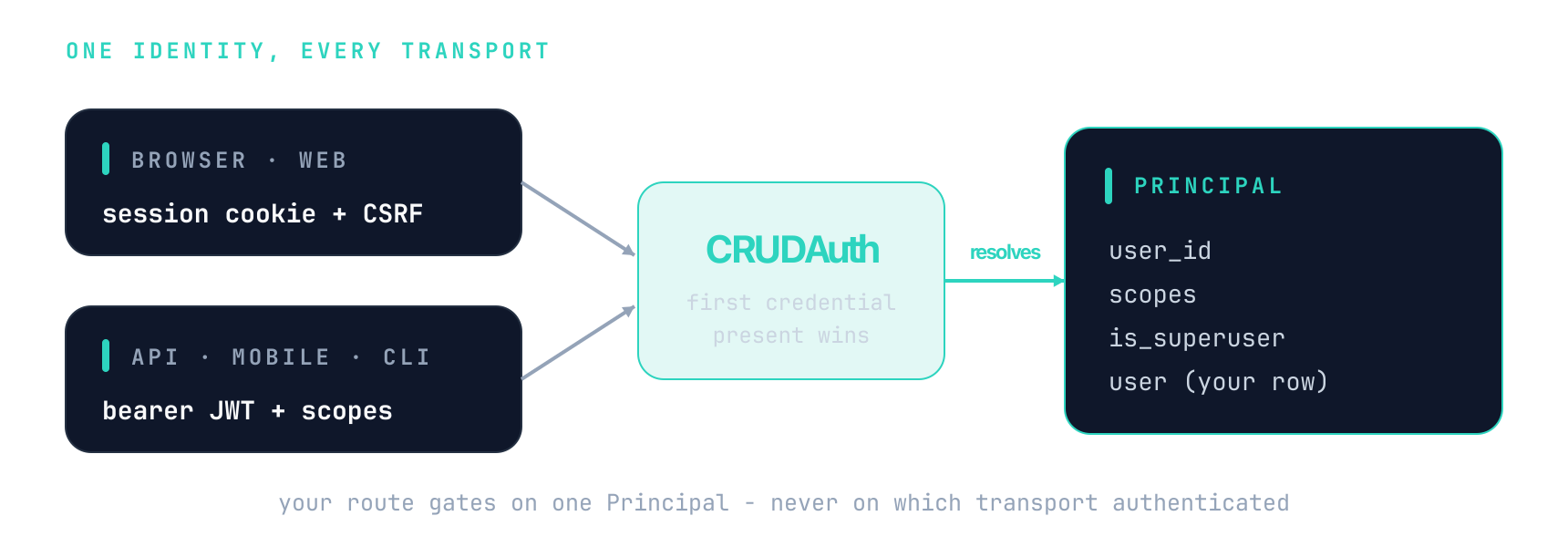
| Field | What it is |
|---|---|
user_id |
The user's primary key. |
is_superuser |
Whether the user holds the superuser flag. |
email_verified |
Whether the user's email is verified. |
scopes |
The capability scopes carried by this credential. |
transport |
Which transport authenticated the request ("session", "bearer", ...). |
user |
Your resolved user row (the ORM instance). |
@app.get("/me")
async def me(user: Principal = Depends(auth.current_user())):
    return {"id": user.user_id, "via": user.transport, "email": user.user.email}
Authorization keywords
Each keyword adds a check. They stack, and a failed check raises the matching status.
auth.current_user()                          # required, 401 if anonymous
auth.current_user(optional=True)             # returns None instead of raising
auth.current_user(superuser=True)            # 403 unless is_superuser
auth.current_user(verified=True)             # 403 unless email_verified
auth.current_user(scopes=["reports:read"])   # 403 unless the credential's scopes cover these
auth.current_user(transport="bearer")        # only accept this transport (or a list)
scopes is a superset check: the credential must carry every scope you list. transport
narrows which credentials are accepted, which is useful when an endpoint should be
API-only or browser-only.
Combining keywords
Keywords compose, so a route can require several things at once:
@app.get("/reports")
async def reports(
    user: Principal = Depends(auth.current_user(superuser=True, verified=True, scopes=["reports:read"])),
):
    ...
Custom checks
check= runs your own predicate on the resolved principal, after the built-in keywords. It
can be sync or async. Returning False denies with 403; to deny with a different status or
message, raise your own exception from inside the check.
def owns_team(user: Principal) -> bool:
    return user.user.team_id is not None

@app.get("/team")
async def team(user: Principal = Depends(auth.current_user(check=owns_team))):
    ...
Returning anything that isn't False (including None) allows the request, so a
raise-to-deny callback that simply returns nothing on success also works.
Optional authentication
Pass optional=True to make a route public but personalized. The dependency returns None
for anonymous callers instead of raising:
@app.get("/products")
async def products(user: Principal | None = Depends(auth.current_user(optional=True))):
    if user is not None:
        ...  # personalize for the logged-in user
    return ...
A present but invalid credential (for example a session cookie that fails its CSRF check on
a mutation) still raises, even under optional=True. A tampered credential is treated as an
attack signal, not as "anonymous".
Resolving outside dependency injection
Middleware and other request-level code can resolve the same principal directly:
@app.middleware("http")
async def audit(request: Request, call_next):
    principal = await auth.resolve_principal(request)
    if principal is not None:
        logger.info("request from user %s", principal.user_id)
    return await call_next(request)
This method returns None for anonymous or invalid credentials, does not enforce CSRF, and does
not slide session activity by default. Pass update_activity=True when middleware should count
the request as session activity.
A later current_user() dependency in the same request reuses the result: it reloads the user
through its own DB session, and still applies its CSRF check, the session activity update and its
authorization gates. Invalid credentials aren't cached, so that dependency still rejects them.
resolve_principal opens its own DB session by calling your session dependency directly, so
FastAPI's dependency_overrides don't apply to it.
Protecting a whole router
Attach the dependency at the router level to gate every route under it:
from fastapi import APIRouter

admin = APIRouter(prefix="/admin", dependencies=[Depends(auth.current_user(superuser=True))])

@admin.get("/stats")
async def stats():
    ...  # already gated; reached only by superusers
Router-level dependencies enforce access but don't inject a value into the handler. If a
route needs the Principal, add current_user() to that route as well.
Composing with rate limits and sudo
current_user() is one dependency among several. Combine it with throttling or
re-authentication on the same route:
from crudauth.ratelimit import RateLimit

@app.post(
    "/account/close",
    dependencies=[Depends(auth.rate_limit("account_close", RateLimit(3, 3600)))],
)
async def close_account(
    user: Principal = Depends(auth.current_user(superuser=False)),
    _: Principal = Depends(auth.require_sudo()),
):
    ...
See the rate limiting and sudo reference pages for those pieces.