Composable Features
Every feature in this boilerplate can be removed. Not "commented out" or "left unused" — deleted, along with its routes, models, settings, admin views, seeders and tests, leaving a project that imports, lints, type-checks and passes its remaining tests.
That works because features never import each other to plug in. A feature exposes plain objects at stable paths, and one package collects them.
The composition root
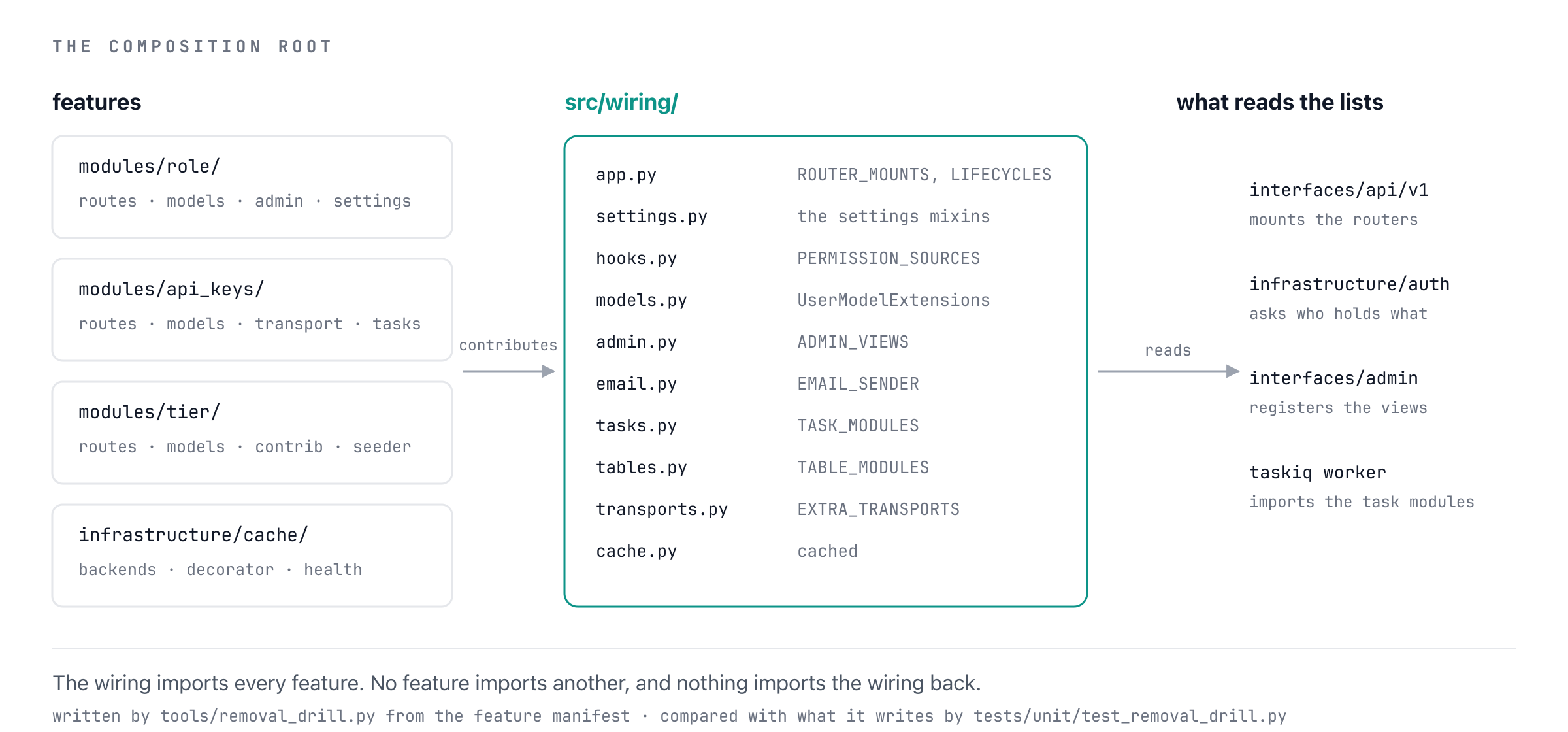
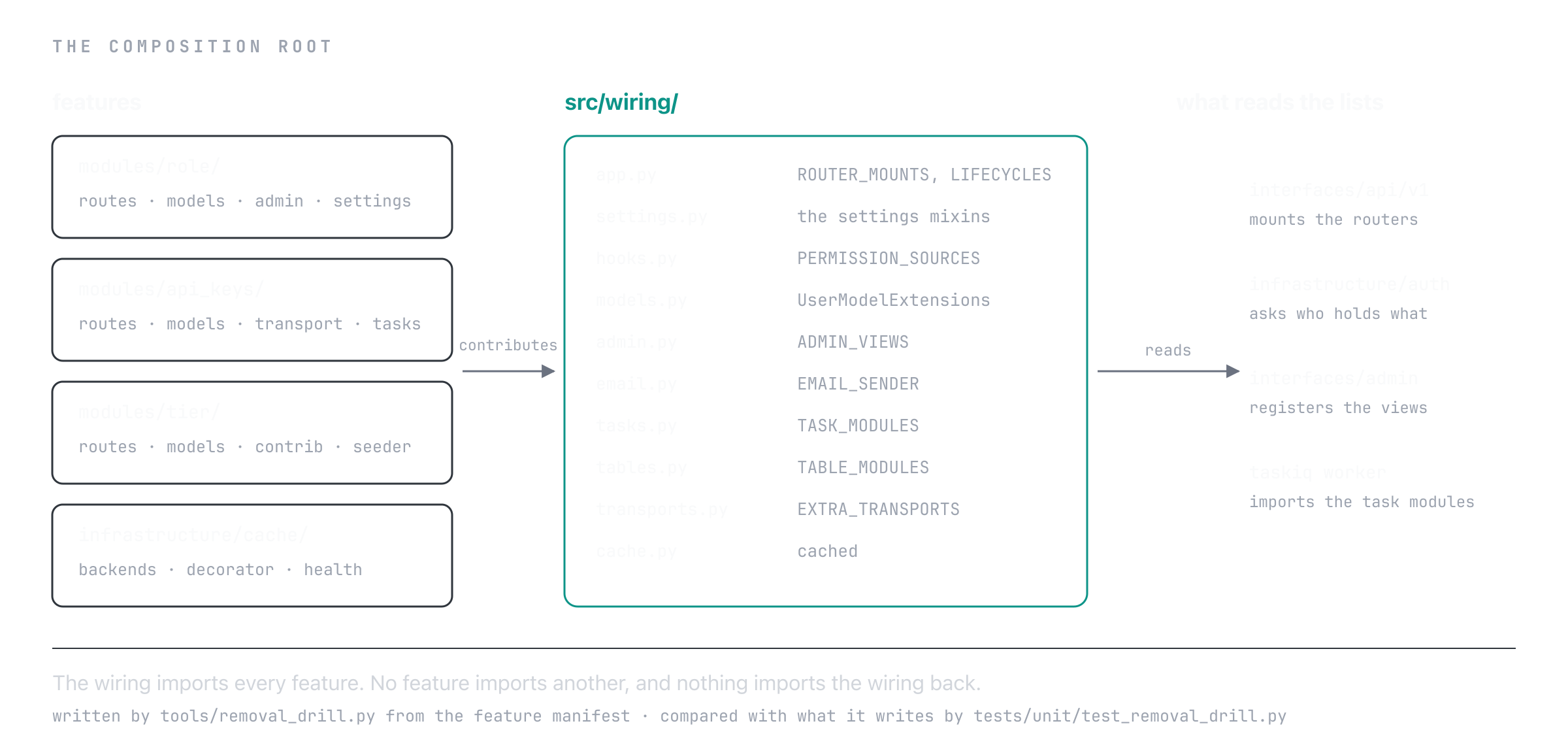
backend/src/wiring/ is the only place features meet:
| File | What it lists |
|---|---|
app.py |
ROUTER_MOUNTS, ROOT_ROUTERS, API_THROTTLE, LIFECYCLES, INSTALLERS, DOCS_GUARD |
settings.py |
each feature's settings mixin, with the core last |
hooks.py |
PERMISSION_SOURCES, RATE_LIMIT_RESOLVERS, TIER_DELETE_GUARDS, TIER_DELETE_RELEASES, CRITICAL_READINESS_CHECKS, INFORMATIONAL_READINESS_CHECKS |
models.py |
UserModelExtensions, UserSchemaExtensions |
admin.py |
ADMIN_VIEWS, and the file itself is absent from a project without the admin feature |
email.py |
EMAIL_SENDER, the sender account mail goes out through: its own module because the senders import the accounts feature that hooks.py reaches |
tasks.py |
TASK_MODULES, the modules whose background tasks the worker registers |
tables.py |
TABLE_MODULES, the modules outside src/modules that declare tables on Base.metadata |
transports.py |
EXTRA_TRANSPORTS, the authentication transports registered beside the session one |
cache.py |
cached, the decorator a route caches its response with, re-exported so a route never imports the cache feature |
Two more live beside the code they drive: backend/scripts/seeders.py lists
SEEDERS, and backend/tests/wiring.py lists the fixture modules pytest loads.
Every one of these files is imports and names: each entry is either a value a feature exposes or a literal naming where to mount it. No decisions are taken here, so ruff, mypy and an IDE see exactly what a project wired. Anything conditional — whether the OAuth router exists, for instance — belongs to the feature that owns it, which exposes the answer for the wiring to list.
The generator writes these files
tools/removal_drill.py writes all twelve from the feature manifest, and
tests/unit/test_removal_drill.py compares what it writes for this project's features
against what is committed here, tree by tree. So adding a feature means teaching the
generator as well as the committed file: an entry in one and not the other fails that test.
The shapes a feature contributes
backend/src/infrastructure/composition.py holds the types:
RouterMount(router, prefix, throttled)— a router to mount under the API prefix.Lifecycle(name, startup, shutdown)— startup and shutdown work, run in wiring order and torn down in reverse.PermissionSource— answers which permissions a user holds.RateLimitResolver— answers the limit for a request, orNoneto decline.TierDeleteGuard— answers why a tier can't be deleted, orNoneto allow it.TierDeleteRelease— removes the rows a feature keeps for a tier that a soft delete already took out, before the tier is permanently deleted.ReadinessCheck(name, check)— a dependency the app needs before it can serve.
A feature that wants to extend the User model contributes a mixin instead: see
modules/tier/contrib.py, which adds tier_id and tier without the user module
knowing that tiers exist.
What each feature owns
| Feature | Needs | Owns |
|---|---|---|
| core | – | everything not listed below, including the permission registry |
| accounts | – | infrastructure/auth/, modules/user/, the first-superuser seeder |
| rbac | accounts | modules/role/ |
| ratelimit | accounts | infrastructure/ratelimit/ |
| tiers | accounts | modules/tier/, the default-tier seeder |
| tier_limits | tiers, ratelimit | modules/rate_limit/ |
| api_keys | accounts | modules/api_keys/ |
| admin | accounts | interfaces/admin/, wiring/admin.py |
| cache | – | infrastructure/cache/ |
| taskiq | – | infrastructure/taskiq/ |
A few files belong to a combination: modules/user/admin.py exists only with
accounts and admin, modules/tier/admin.py only with tiers and admin, and
modules/role/admin.py only with rbac and admin.
Checking that removal still works
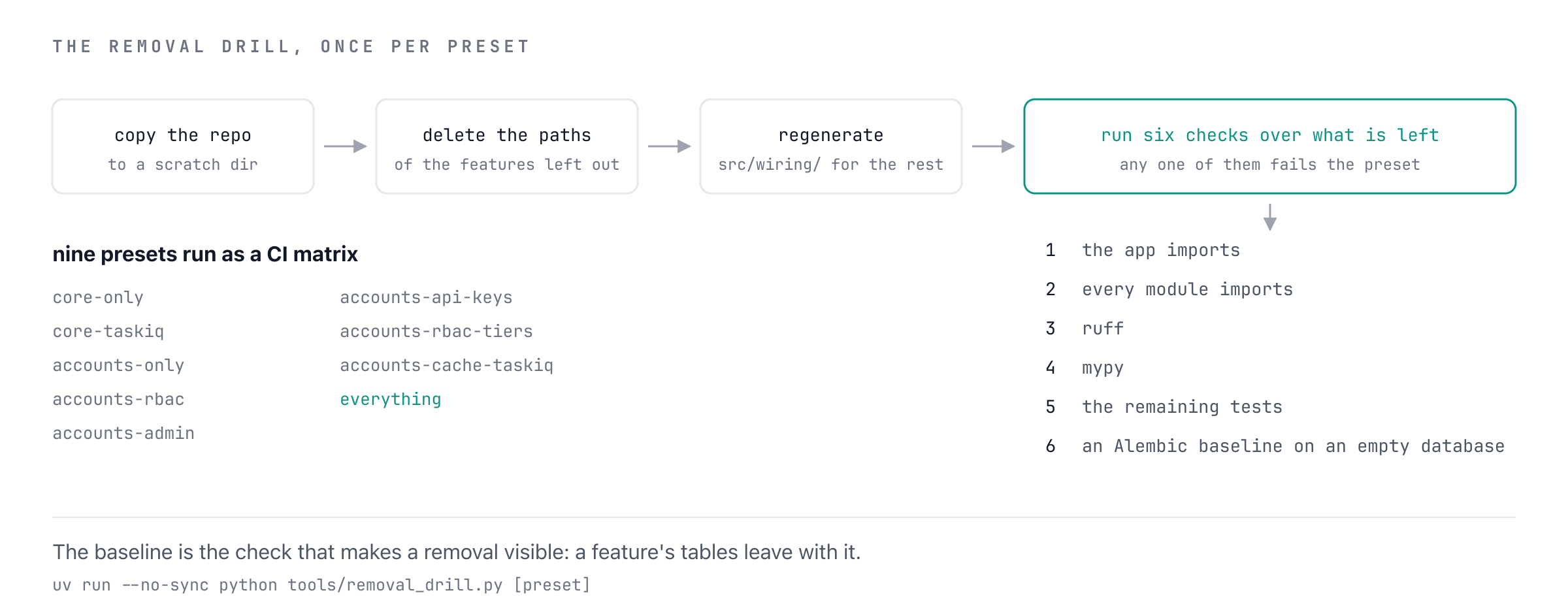
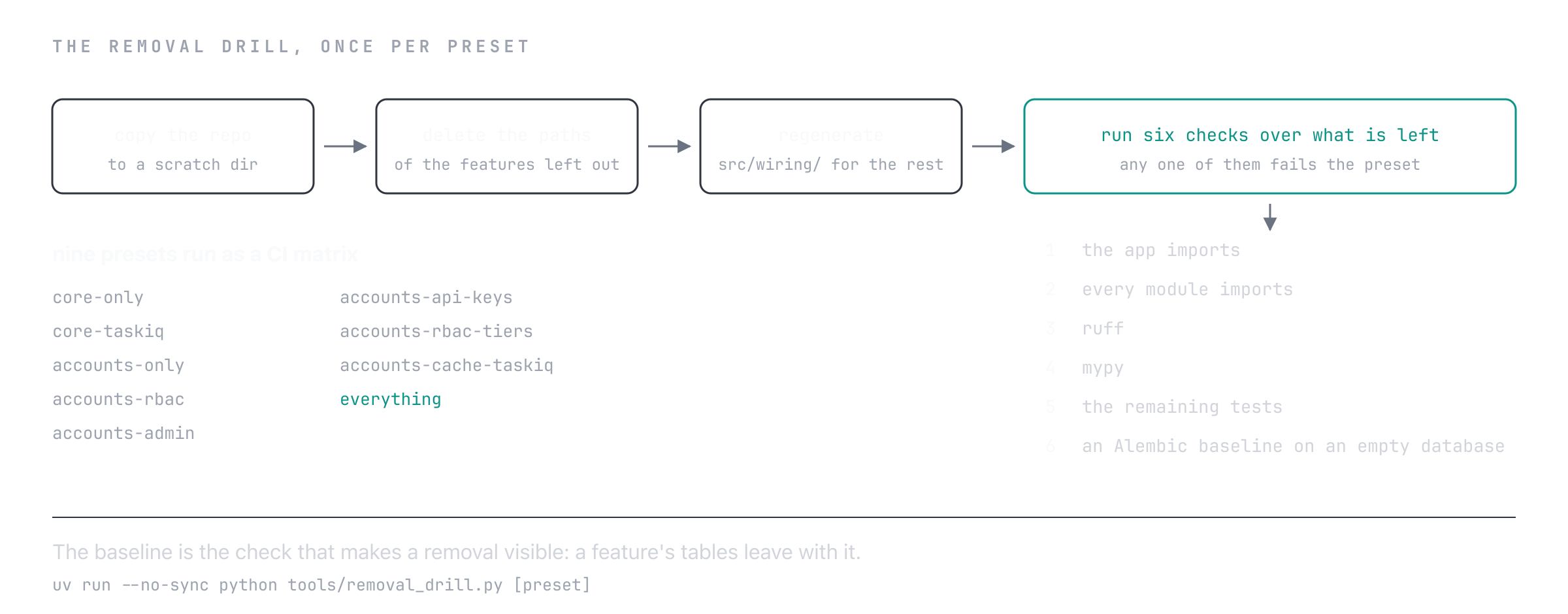
tools/removal_drill.py builds a copy of the repository for a set of features,
deletes the paths of the ones left out, regenerates the wiring, and then checks
that the app imports, that every module imports, that ruff and mypy pass over
src scripts migrations tests, and that the remaining tests pass.
The generator is held to the wiring this repository commits:
tests/unit/test_removal_drill.py regenerates src/wiring/, scripts/seeders.py and
tests/wiring.py for the features a project carries and compares the result tree by
tree, ignoring docstrings and formatting. A contribution added to any of those files by
hand and not to the generator fails there.
A failing check prints the end of what it printed — the failing test, the ruff rule, the mypy error — and the scratch copy of that project is left on disk to run things in by hand. A build that raises leaves its copy behind too.
It runs on the interpreter that invoked it, so run it through uv (the checks need the project's dependencies) and with Docker up (the tests use a Postgres container, and a RabbitMQ one where the taskiq feature is present):
uv run --no-sync python tools/removal_drill.py                 # every preset
uv run --no-sync python tools/removal_drill.py accounts-only   # one of them
uv run --no-sync python tools/removal_drill.py --keep          # keep the scratch copies
The presets run in CI as a matrix:
| Preset | What it proves |
|---|---|
core-only |
every feature can go at once |
core-taskiq |
the worker runs with no accounts feature, so it registers no account mail |
accounts-only |
permission checks fall back to superuser-only without rbac |
accounts-rbac |
permissions work without tiers, throttling, cache or taskiq |
accounts-admin |
the panel registers only the views the project's features own |
accounts-api-keys |
keys authenticate, narrow and count without rbac, tiers or the cache |
accounts-rbac-tiers |
tiers and the API throttle work without per-tier limits |
accounts-cache-taskiq |
the infrastructure features stand alone |
everything |
a regenerated wiring reproduces this repository |
The drill is also how a misplaced test gets caught: a test that quietly depends on a feature it doesn't own fails in the preset that removes it.
Writing a feature that can be removed
- Keep everything the feature owns under its own paths, and add those paths to the drill's manifest.
- Import another feature only if the table above says you need it.
- To reach into another feature, contribute to a hook rather than importing it.
- Put the feature's settings in its own
settings.pyand its fixtures intests/fixtures/, then list both in the wiring. - Run the drill. If a preset that excludes your feature fails, something of yours is in a path the drill doesn't delete.